The Materials · Tagua
The nut that replaced ivory.
A seed hard enough to carve like bone, light enough to wear all day, and sustainable enough to feel genuinely good about.
Origin & Impact→Tagua
What is tagua?
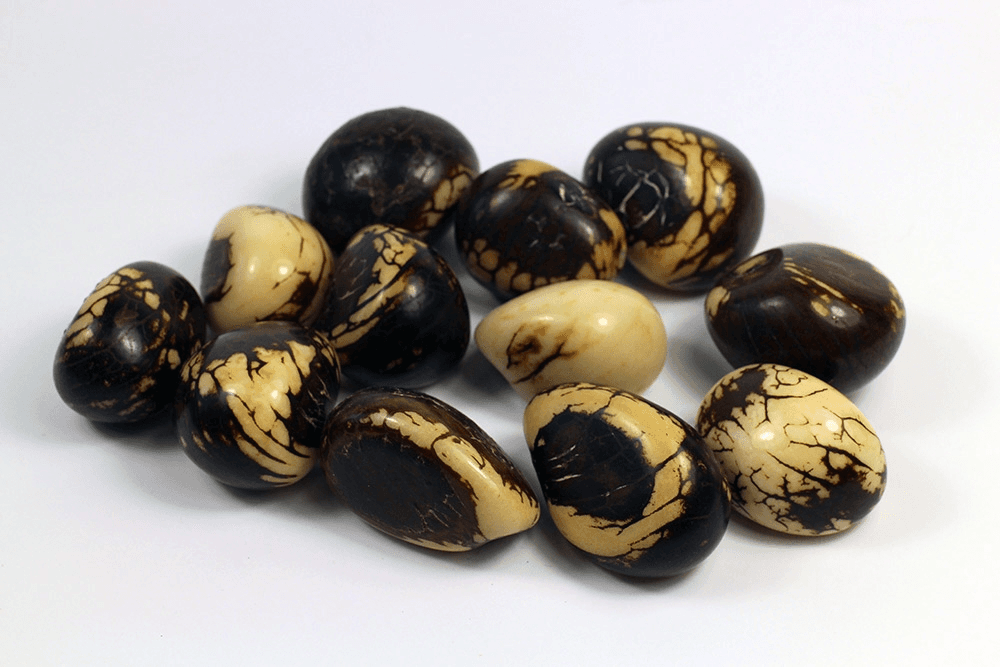
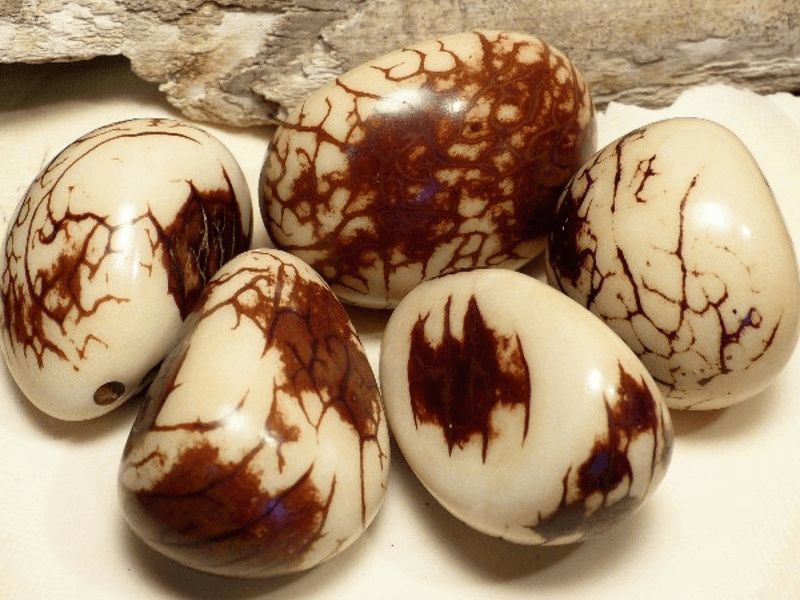
The tagua nut is the seed of the Phytelephas aequatorialis palm — a tree that grows in the humid lowlands of Ecuador's Pacific coast and Andean foothills. When the nuts are harvested and dried naturally over several months, they develop a density and hardness almost identical to elephant ivory — which is why tagua has been known internationally as "vegetable ivory" since the 19th century. Unlike synthetic substitutes, tagua is 100% natural, biodegradable, and renewable. Each palm produces several clusters of nuts per year without being harmed or cut down. The harvest is entirely manual. The drying is entirely solar. There are no chemicals, no heavy machinery, and no waste.
Why tagua matters
A material that protects what it comes from.
In the 1880s, tagua was the world's primary button material — a global trade that sustained Ecuadorian coastal forest communities for decades and gave the palm forests an economic reason to exist. When plastic arrived in the mid-20th century, demand collapsed almost overnight, and with it the incentive to protect the forest. Today, the revival of tagua in fine jewellery and design is not just an aesthetic choice — it is an ecological argument. The more valuable the nut, the more reason to protect the palm. The more reason to protect the palm, the more reason to protect the forest around it. Every Urkaya tagua piece is, in a quiet way, an act of habitat conservation.
Material Properties
What makes it exceptional.
Hardness
Comparable to hardwood; carves cleanly without splintering
Colour
Natural white to warm ivory; accepts natural dyes with exceptional depth
Texture
Smooth, warm, subtly grainy — similar to bone, never cold or synthetic
Durability
Highly resistant to chipping; hardness increases with age
Weight
Significantly lighter than stone or metal — ideal for all-day wear
Origin
Ecuador, primarily Manabí Province · HS Code: 960200
The Craft Process
Eight steps by hand.
01
Harvest
Seed clusters fall naturally or are collected by hand from the forest floor — never by cutting the palm.
02
Solar Drying
Nuts dry naturally over 2–6 months, hardening to their characteristic ivory colour without chemicals.
03
Selection
Each nut is assessed individually: colour uniformity, absence of cracks, density. Imperfect nuts are set aside.
04
Rough Cutting
The selected nut is sawn into blanks using hand tools, guided by the artisan's reading of the grain.
05
Carving
Each blank is shaped, detailed, and refined by hand. No CNC. No automation.
06
Dyeing
Where colour is specified, natural plant-based dyes are applied and heat-set. No synthetic colorants.
07
Polishing
Each piece is hand-polished through progressively finer grades to a smooth, warm, luminous finish.
08
Quality Check
Rosa or Ana inspects each finished piece before it enters the Urkaya collection.
Caring for tagua
Water
Avoid prolonged submersion. Remove before swimming or bathing.
Cleaning
Wipe gently with a soft, dry cloth. No chemical cleaners.
Storage
Keep in a cool, dry place away from direct sunlight. Extended UV exposure may fade natural dyes.
Durability
Tagua is hard but not indestructible. Avoid dropping onto hard surfaces.
The Collection